The Death and Life of Great American Cities by Jane Jacobs
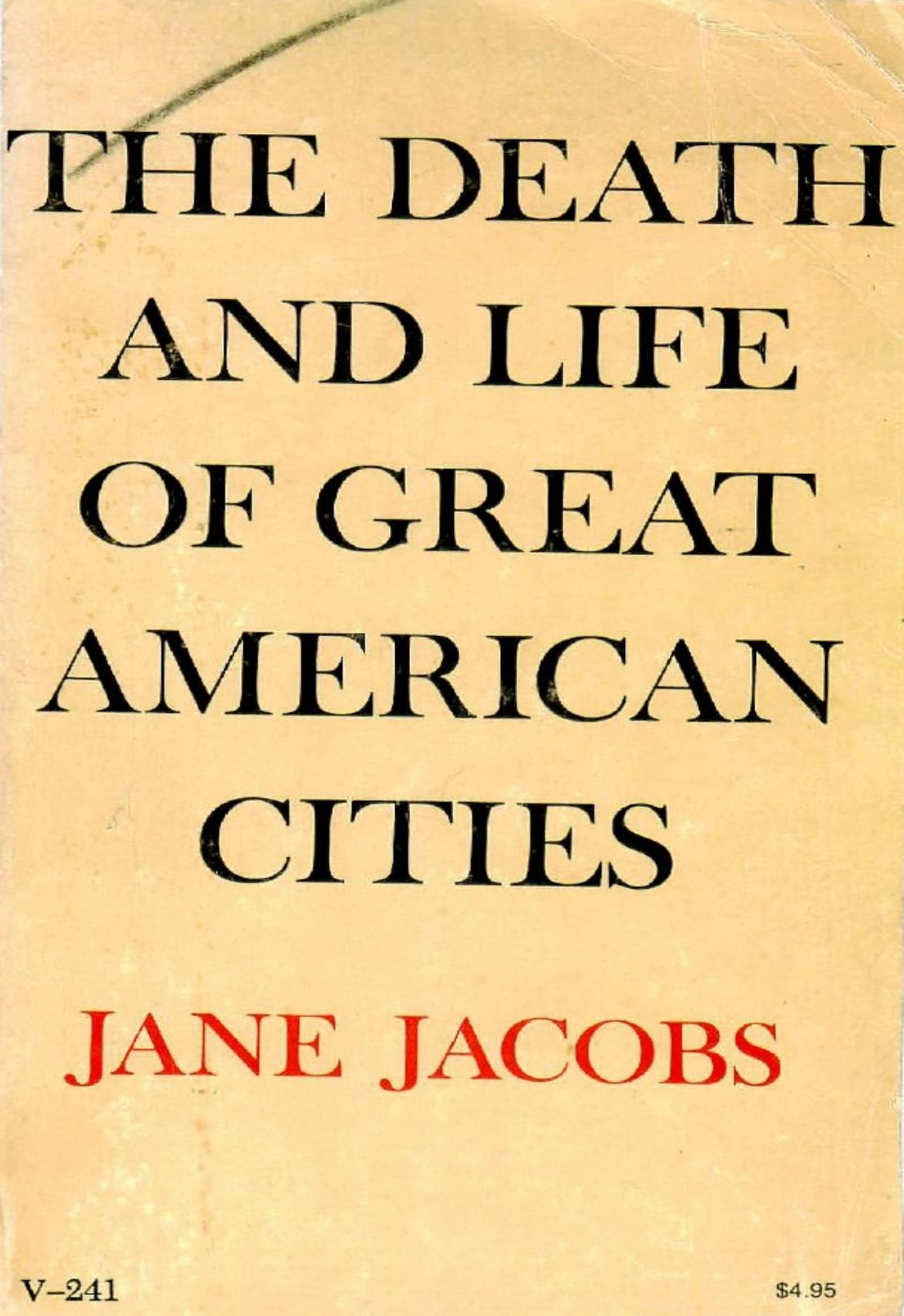
Author:Jane Jacobs
Language: eng
Format: epub, azw3, pdf
Tags: Social Science, Sociology, Urban
Publisher: Vintage
Published: 2016-07-20T05:00:00+00:00
Considering the hazard of monotony…the most serious fault in our zoning laws lies in the fact that they permit an entire area to be devoted to a single use.
In seeking visual order, cities are able to choose among three broad alternatives, two of which are hopeless and one of which is hopeful. They can aim for areas of homogeneity which look homogeneous, and get results depressing and disorienting. They can aim for areas of homogeneity which try not to look homogeneous, and get results of vulgarity and dishonesty. Or they can aim for areas of great diversity and, because real differences are thereby expressed, can get results which, at worst, are merely interesting, and at best can be delightful.
How to accommodate city diversity well in visual terms, how to respect its freedom while showing visually that it is a form of order, is the central esthetic problem of cities. I shall deal with it in Chapter Nineteen of this book. For the moment, the point is this: City diversity is not innately ugly. That is a misconception, and a most simple-minded one. But lack of city diversity is innately either depressing on the one hand, or vulgarly chaotic on the other.
—
Is it true that diversity causes traffic congestion?
Traffic congestion is caused by vehicles, not by people in themselves.
Wherever people are thinly settled, rather than densely concentrated, or wherever diverse uses occur infrequently, any specific attraction does cause traffic congestion. Such places as clinics, shopping centers or movies bring with them a concentration of traffic—and what is more, bring traffic heavily along the routes to and from them. A person who needs or wants to use them can do so only by car. Even a grade school can mean traffic congestion in such a milieu, because children must be carried to school. Lack of wide ranges of concentrated diversity can put people into automobiles for almost all their needs. The spaces required for roads and for parking spread everything out still farther, and lead to still greater uses of vehicles.
This is tolerable where the population is thinly spread. It becomes an intolerable condition, destructive of all other values and all other aspects of convenience, where populations are heavy or continuous.
In dense, diversified city areas, people still walk, an activity that is impractical in suburbs and in most gray areas. The more intensely various and close-grained the diversity in an area, the more walking. Even people who come into a lively, diverse area from outside, whether by car or by public transportation, walk when they get there.
—
Is it true that city diversity invites ruinous uses? Is permissiveness for all (or almost all) kinds of uses in an area destructive?
To consider this, we need to consider several different kinds of uses—some of which actually are harmful, and some of which are conventionally considered to be harmful but are not.
One destructive category of uses, of which junk yards are an example, contributes nothing to a district’s general convenience, attraction, or concentration of people. In return for nothing, these uses make exorbitant demands upon the land—and upon esthetic tolerance.
Download
The Death and Life of Great American Cities by Jane Jacobs.azw3
The Death and Life of Great American Cities by Jane Jacobs.pdf
This site does not store any files on its server. We only index and link to content provided by other sites. Please contact the content providers to delete copyright contents if any and email us, we'll remove relevant links or contents immediately.
| Anthropology | Archaeology |
| Philosophy | Politics & Government |
| Social Sciences | Sociology |
| Women's Studies |
Cecilia; Or, Memoirs of an Heiress — Volume 1 by Fanny Burney(32569)
The Great Music City by Andrea Baker(32034)
Cecilia; Or, Memoirs of an Heiress — Volume 2 by Fanny Burney(31968)
Cecilia; Or, Memoirs of an Heiress — Volume 3 by Fanny Burney(31948)
We're Going to Need More Wine by Gabrielle Union(19060)
All the Missing Girls by Megan Miranda(16077)
Pimp by Iceberg Slim(14536)
For the Love of Europe by Rick Steves(14214)
Bombshells: Glamour Girls of a Lifetime by Sullivan Steve(14087)
Talking to Strangers by Malcolm Gladwell(13392)
Norse Mythology by Gaiman Neil(13387)
Fifty Shades Freed by E L James(13250)
Mindhunter: Inside the FBI's Elite Serial Crime Unit by John E. Douglas & Mark Olshaker(9356)
Crazy Rich Asians by Kevin Kwan(9302)
The Lost Art of Listening by Michael P. Nichols(7515)
Enlightenment Now: The Case for Reason, Science, Humanism, and Progress by Steven Pinker(7320)
The Four Agreements by Don Miguel Ruiz(6772)
Bad Blood by John Carreyrou(6629)
Weapons of Math Destruction by Cathy O'Neil(6290)
